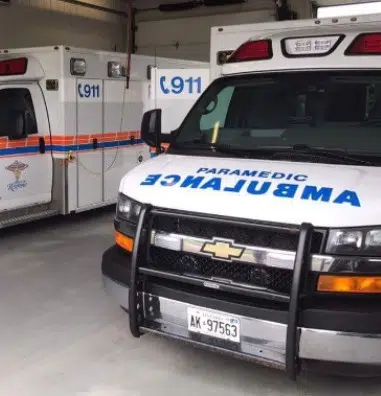
The County of Renfrew Paramedic Service has partnered with five local hospitals to roll out a program aimed at reducing ambulance offload delays and getting paramedics back on the road faster.
The Fit2Sit initiative, launched late last year, allows paramedics to transfer certain low-acuity patients from ambulance stretchers to designated seating areas in hospital emergency departments, freeing up stretchers and returning crews to service more quickly.
Under the program, paramedics assess patients during transport to determine whether they are stable, fully conscious, able to sit or stand independently and not in distress. Patients who meet those criteria — and who are appropriately clothed — can be guided to a waiting room chair upon arrival at hospital, where they continue to be monitored by staff.
Higher-acuity patients or those requiring immediate medical attention remain under paramedic care or are transferred directly to a hospital stretcher in the emergency department.
Nick LeRiche, deputy chief of operations with the County of Renfrew Paramedic Service, said the program does not change the level of care patients receive.
“For patients, the experience remains straightforward. Those who qualify for Fit2Sit simply wait in the emergency department’s designated seating area, where they are monitored, just like any other patient in the waiting room,” LeRiche said. “The sickest and most urgent patients are still prioritized by hospital staff.”
The initiative is endorsed by Ontario’s Ministry of Health and has been adopted in several other parts of the province, including Waterloo Region, Simcoe County, Kawartha Lakes, Peel Region and Nipissing District.
Local emergency department teams at Arnprior Regional Health, Deep River and District Health, Pembroke Regional Hospital, Renfrew Victoria Hospital and St. Francis Memorial Hospital received training before the program’s implementation.
Officials say the approach supports patient flow in busy emergency departments by reducing the time ambulances spend waiting to offload patients. By clearing stretchers more quickly, paramedic crews are able to respond sooner to other calls in the community.
LeRiche said the program is rooted in collaboration between paramedic services and hospitals and is designed to improve community safety.
“By enabling paramedics to return to service more quickly, the entire community benefits,” he said. “Whether responding to a sudden medical emergency, a serious injury or a life-threatening situation, having paramedics back on the road sooner ensures that critical care reaches those who need it most without delay.”
(Steve Berard)